
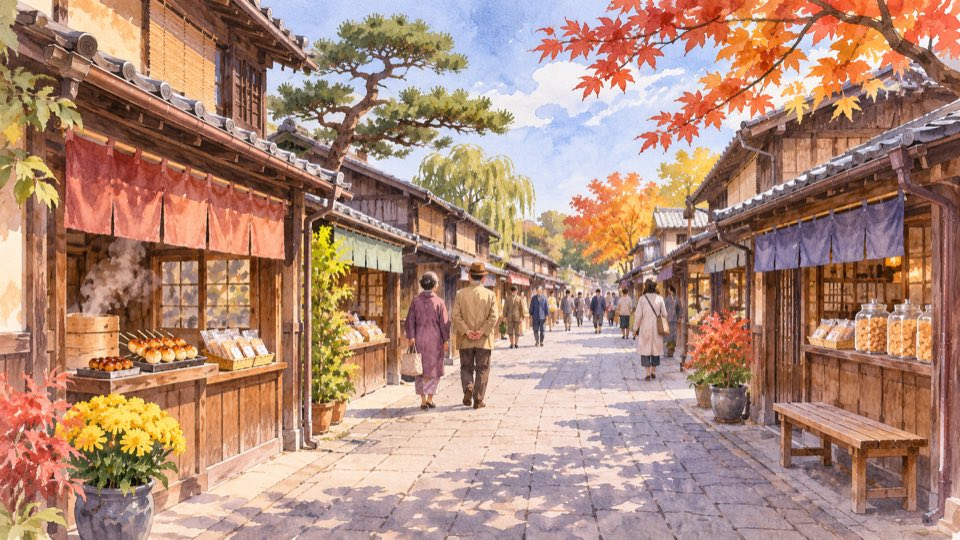
From Chofu Station, a short bus ride brings you to a thatched temple gate and a neighborhood where lunch means buckwheat noodles. Start at Jindaiji Temple, choose a soba shop, then spend the afternoon in the botanical garden or paint a piece of pottery to take home. Pick one afternoon stop if you have half a day. That leaves time for a lunch queue or a slower walk back to the bus. The cover is a watercolor illustration inspired by a temple neighborhood in autumn.
- Getting there: Take the bus from Chofu Station
- Jindaiji Temple: Look back at the thatched gate
- Where to eat Jindaiji soba: Three shops for different plans
- Afternoon option 1: Jindai Botanical Gardens
- Afternoon option 2: Paint a piece of pottery at Musashino Jindaiji Kiln
- Visiting on a Monday or Thursday?
Getting there: Take the bus from Chofu Station
At Chofu Station on the Keio Line, exit on the north side. At bus stand 11, take Cho 34 (調34) bound for Jindaiji (深大寺). The temple estimates about 15 minutes on the bus. Get off at the last stop, Jindaiji, about a minute from the gate on foot. Jindaiji Iriguchi (深大寺入口) is a different stop, about an eight-minute walk from the temple. Use the Jindaiji terminus for the return if you want to retrace your steps. Jindaiji Temple access information
| Suggested time | Plan |
|---|---|
| Around 10:15 a.m. | Arrive at Jindaiji and visit the gate, main hall and temple grounds. |
| Around 11:15 a.m. | Stop for lunch. If you have a shop in mind, go early. |
| Around 12:30 p.m. | Visit the garden and greenhouse, or paint pottery near the temple gate. |
| Around 2:00–2:30 p.m. | Catch a bus back to Chofu, allowing time to wait for it. |
Jindaiji Temple: Look back at the thatched gate
The wooden Sanmon is the oldest surviving building at Jindaiji. Once you pass through it, turn around to see the depth of the thatch. Continue to the main hall and, if you have time, the Ganzandaishi Hall. The Shaka Hall houses a bronze seated Shakyamuni designated a National Treasure. If lunch is your priority, the gate, main hall and Shaka Hall make an easy short visit.
Temple hours and access
Entry to the grounds is free. The temple grounds open 5 a.m.–6 p.m. between the spring and autumn equinoxes, and 6 a.m.–5 p.m. for the rest of the year. The Tokyo accessibility guide details a ramp between the main hall and Ganzandaishi Hall. Temple buildings and treasures · Tokyo accessibility guide
Where to eat Jindaiji soba: Three shops for different plans

Mori soba comes chilled with a cup of dipping sauce. Dip a small bundle of noodles at a time. On a cold day, look for kake soba served in hot broth. On Japanese menus, nihachi generally means 80% buckwheat flour, kuwari 90%, and juwari 100%. Which shop works best depends on your route, the seats you need and the day you visit. Chofu Tourism Association’s Jindaiji soba guide
Yusui: Try 90% or 80% buckwheat noodles
Yusui is about two minutes west of the Jindaiji bus stop. The menu lists chilled 90% buckwheat mori soba at ¥850. The 80% version is ¥800. For a fuller lunch, the ¥1,700 Yusui ten-mori comes with shrimp and vegetable tempura.
The shop usually opens at 10:30 a.m. and closes on Thursdays. Bring cash, as the shop says it does not accept cards. Yusui official site · English menu and ingredients
Tamanoya: Lunch at the botanical garden’s Jindaiji Gate
Choose Tamanoya for 100% buckwheat soba made with flour milled in-house and a setting beside the trees. The restaurant is by the garden’s Jindaiji Gate, which makes it an easy stop on the walk from the temple.
The tourism association lists hours of 10 a.m.–4 p.m. on weekdays and 9:30 a.m.–4:30 p.m. on weekends and holidays. It closes Mondays, or the following day if Monday is a public holiday. Tamanoya official site · Chofu Tourism Association listings
Matsuba Chaya: Smaller portions and seating options for families
This shop near the garden’s Jindaiji Gate lists 80% and 100% buckwheat noodles, child seats, and mini portions of soba or udon. There is indoor and outdoor seating. If you have a stroller, ask the staff which tables can accommodate it. It closes Mondays, or the following day if Monday is a public holiday. It shares a street address with Tamanoya, so use the shop name to find it on the map. Matsuba Chaya menu and shop details
Afternoon option 1: Jindai Botanical Gardens
When the garden’s Jindaiji Gate is open, you can continue there on foot from the temple neighborhood. For an hour-long visit, pair the main greenhouse with one seasonal outdoor stop. If roses are the main draw, check the garden’s bloom reports before heading out. The temple is spelled Jindaiji in English and the garden Jindai.
Garden hours, tickets and access
The garden opens 9:30 a.m.–5 p.m. Last entry is at 4 p.m. The main greenhouse closes at 4:30 p.m. Admission is ¥500 for adults, ¥250 for people aged 65 and over, and ¥200 for junior high school students. Elementary school children and younger enter free, as do junior high students who live or study in Tokyo.
The garden closes on Mondays. If Monday is a public holiday, a substitute holiday or Tokyo Citizens’ Day, the garden closes the following day. It also closes December 29–January 1.
To visit the garden first, get off the Cho 34 bus at Jindai Shokubutsu Koen (神代植物公園). The map shows the garden’s main entrance. Jindai Botanical Gardens visitor information
Afternoon option 2: Paint a piece of pottery at Musashino Jindaiji Kiln
At the pottery studio below the temple gate, pick a pre-fired blank and paint it. The rakuyaki option starts at ¥600. Firing takes about 20 minutes after you finish painting, and you can take the piece home that day. Budget about 45–60 minutes for choosing, painting and firing.
The studio takes walk-ins only and hands out same-day tickets when it gets busy. If painting is the main reason for your visit, ask about availability before going up to the temple.
Studio hours and last admission
The studio opens 11 a.m.–5 p.m. on weekdays. On weekends and holidays it opens at 10 a.m. Activities accept visitors until around 4 p.m. In November 2026 it closes Tuesdays, Wednesdays and Thursdays except public holidays. Check the calendar for your visit, as closure days vary by month. Studio calendar · Pottery painting options
Visiting on a Monday or Thursday?
On a regular Monday, the garden, Tamanoya and Matsuba Chaya are all closed. Try the temple grounds, lunch at Yusui and pottery painting if the studio is open. You can do that entire route without entering the garden.
On a regular Thursday, Yusui is closed, so try Tamanoya or Matsuba Chaya if you’re combining lunch with the garden. Hours and prices were checked on November 18, 2026. Check the official pages for holiday hours and temporary changes.
コメント